
By Vinola Vincent Munyon
There’s the Rajasthan that the world is familiar with. The color-saturated imminently “gram-able” Rajasthan. This Rajasthan is the land of the maharajas, of palaces turned heritage hotels, home to the pink city, the blue city, the golden city, the city of lakes, wildlife sanctuaries, and natural parks. The Rajasthan that draws tourists from all over the world.

Then there’s the other Rajasthan. The Rajasthan that Govind Singh Rathore grew up in. In this Rajasthan, behind picture-perfect blue walls, young Govind observed how patriarchy and the rigid caste system governed every aspect of life. At age 15, Govind would lose his father and, by virtue of being the oldest son, find himself overnight the head of the household. His mother’s status as a widow and the overt ways in which she was ostracized from participating in the community soon led him to conclude that widows and single mothers, seen in the eyes of a deeply patriarchal society as “incomplete women” (since their man who completed them was no more), occupied the bottom rung of the oppression ladder.
The data on educational attainment among women in Rajasthan paints a vivid picture. Women in only 13.6% of the households go on to attain a high school education. In over 36.5% of the households, the women receive no formal school education. Even more dismal, Rajasthan is ranked second among the states in India for overall crimes committed against women and first for the highest number of rapes reported. As scary as these statistics are, they are widely known to be based on underreported or suppressed data.
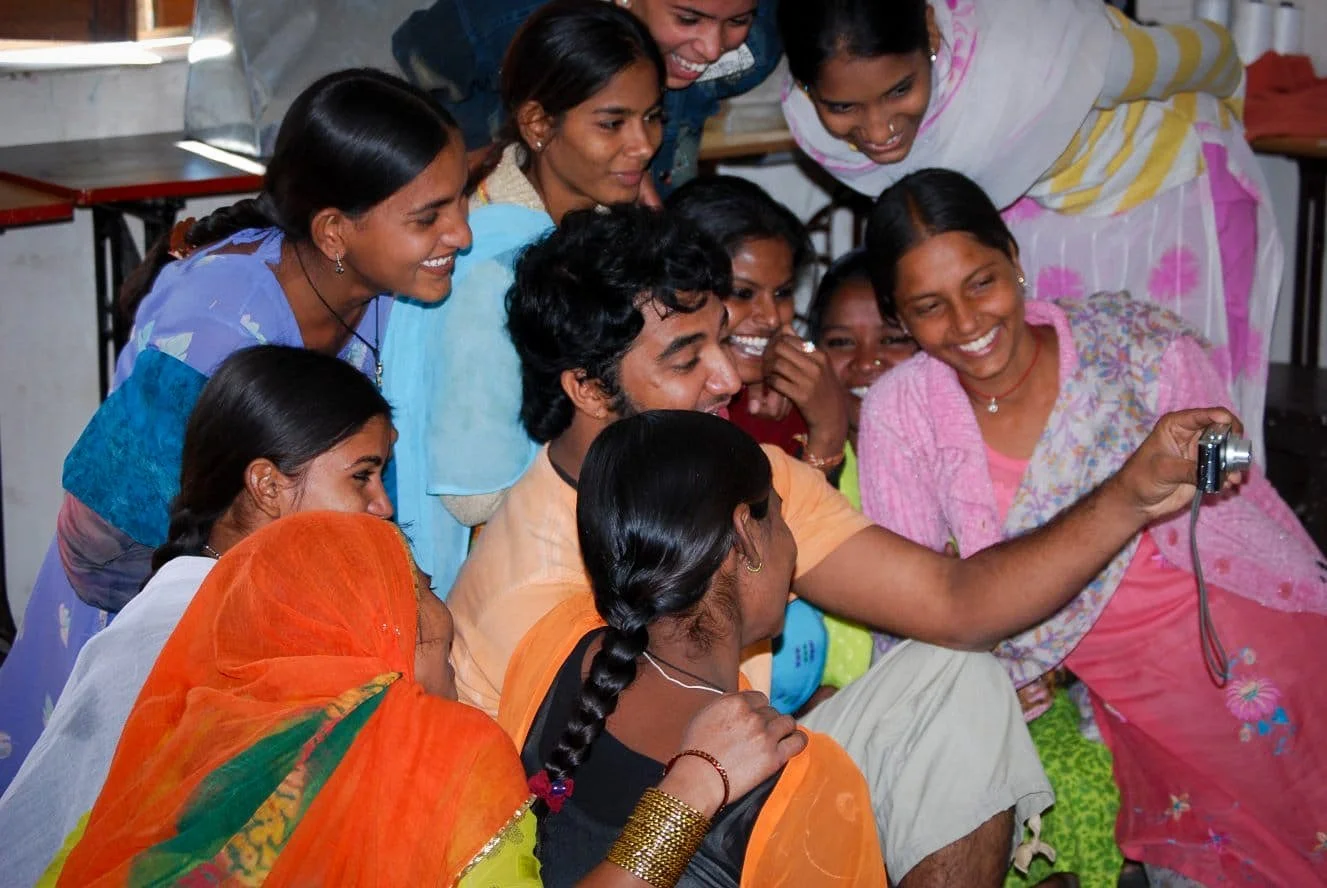
Govind at his first Empowerment Center
Govind was 20, married and running the family business, a modest guesthouse. He was continuing to ruminate on the treatment he saw meted out to women when he became convinced that access to literacy was the first step that would enable women to climb up the oppression ladder. Financial independence, he reckoned, was the second step. With this conviction he invited Sumitra, one of the workers at the guesthouse, to bring her two daughters over when she came to work so he could tutor them, as he knew they were not attending school. Sumitra showed up the following day with not two, but 18 girls and young women.
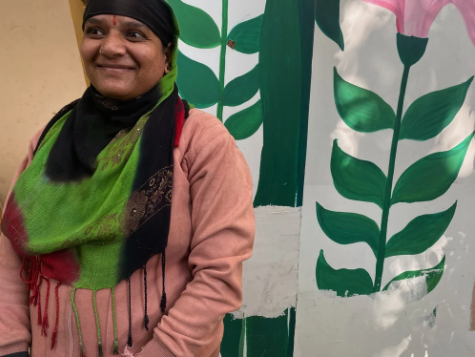
Vandana was 15 and being prepared to be married to a much older man. When pleas to be allowed to remain single, and a student, went unheard by her family, she took her pleas to her future in-laws. She requested that she be allowed to at least continue with her education after the wedding, a plea that they surprisingly agreed to. Less surprising was the fact that once she was in her marital home, not only did they renege on the agreement to allow her to continue to study, but also forced her into quickly becoming a mother. An unwilling and unhappy participant in the life story scripted for her by her in-laws, Vandana discovered that she wasn’t even to receive the solace one would expect through companionship with one’s spouse. Her spouse was an abusive, adulterous, alcoholic, and Vandana was almost always the target of his rage. Pregnant with their third child, a daughter, Vandana was at a cousin’s wedding when her spouse abandoned her and their younger son and fled with their older son. One would assume that this meant she was released from this marriage, callous though the means, but her birth family, fearful of the stigma associated with her being “returned” to them minus a son, forced her to go back to her marital family and attempt to reconcile with her abusive spouse. He would refuse to reconcile and would also refuse to grant a divorce, providing her with no explanation whatsoever as to why he was behaving so spitefully, thus condemning her to a lifetime of being ostracized by her community and to raising her son and daughter as a single mother.
Manisha Sain was the first in her family to finish secondary school. She then went on to college, to earn a bachelor’s degree and then a graduate degree in Geography. In a society where schooling is most often interrupted for girls in favor of marriage to a man of the parents’ choosing, with no input or consent from the girl, Manisha got to decide the terms under which she would consent to a betrothal. She was able to convince her parents to: 1. Permit her to continue her graduate studies, 2. Choose prospective grooms who would agree to support her toward completing her graduate studies and to seek employment, 3. Choose only potential grooms who lived in the city of Jodhpur and 4. Choose only men who were educated. In a world where girls are unwilling and silenced participants in the scripting of their life story, relegated to being a part of the background, Manisha writes her own script and is unapologetically the main character.

Manisha at Sheerni Boarding Home

Manisha teaching at a Primary Education Center
Govind, Vandana and Manisha’s life stories, distinctively different yet bound by a common denominator that is a passion for empowerment, would intersect at different inflection points in their life at Sambhali.
When Govind set out with the humble goal of teaching two girls some life skills but found himself confronted by a party of 18 women and girls who showed up for an education, he fully committed to the vision that had been brewing since he was 15 and had understood his mother’s place in their community. That vision was to build an organization that would provide women and girls of Rajasthan a safe space and access to education and financial independence.
Sambhali Trust was founded in 2007 with the goal to teach basic Hindi, English, mathematics and sewing, at no cost, to women and adolescent girls in the city of Jodhpur, the rural village of Setrawa, and later the city of Jaisalmer, through the establishment of Empowerment Centers.
Shortly thereafter these same spaces where women and adolescent girls learned in the mornings were expanded to include Primary Education Centers for children in the afternoon. Manisha Sain showed up at Sambhali’s Primary Education Center in Setrawa as a six-year-old with a passion for learning and began her long relationship with Sambhali Trust that took her to Sambhali boarding homes in Jodhpur where she studied through graduate school, along the way teaching at Sambhali Primary Education Centers in Jodhpur and Setrawa.
Vandana would come to Sambhali as a single mother, abandoned by her husband and her birth family, with the burning desire to be independent. She’d begin at the Empowerment Center and soon learn sewing, basic literacy and numeracy, and self-defense skills, paving the way for her to control her own future.
From its beginnings as a vehicle to provide education for Rajasthani women and girls, Sambhali Trust today has evolved into a suite of interconnected programs fostering dignity and self-confidence through learning. All programs are free. Almost all of these programs are focused on women, girls, and, most recently, members of the LGBTQ+ community, but there is also a focus on intergenerational learning, with the knowledge that educating both mothers and their children will form the foundation to change the trajectory for future generations.
Nineteen years after Govind gave his vision a concrete home, Sambhali has, through its many vehicles, reached over 75,000 women, children, and members of the LGBTQ+ community. Awards and national and global recognition have followed, including the Mahatma Gandhi Peace Award, Indira Mahila Shakti Honor, and Special Consultative Status by the Economic and Social Council (ECOSOC) of the United Nations.
Today, Govind Singh Rathore continues to work to expand the reach of Sambhali Trust’s mission and to ensure that the Trust lives up to the meaning behind its name, “to strengthen and uplift the deprived.” Today, Manisha Sain has finished a master’s degree, is applying for another degree in teaching, and recently got married, having successfully delayed marriage until she was ready. Vandana is financially independent, earning her living as a delivery driver, a job that she was connected to through Sambhali Trust and which provides her with flexible hours that allow her to be present in her children’s lives.
Govind’s Rajasthan, Manisha’s Rajasthan and Vandana’s Rajasthan are the Rajasthan where women and girls are no longer silent props in their own life stories. In this Rajasthan, there is poverty, heartbreak, and strife but there is also determination, perseverance, and empowerment. To tip the scales more toward the latter, to have more Manisha’s and Vandana’s, to empower more girls and women to loudly script their own lives, these stories need to not just be heard, and told, but amplified.